2. Number Line and Whole Number Operations Using a Number Line
. Introduction to Number Lines
A number line is a straight line with numbers placed at equal intervals along its length. It extends infinitely in both directions.
- Left side: Smaller numbers or negative numbers (if included)
- Right side: Larger numbers or positive numbers
Key Points:
- Zero (0) is the center of the number line (if considering positive and negative numbers), but for whole numbers, we start from 0 and move right.
- The number line helps in visualizing operations such as addition, subtraction, multiplication, and division.
2. Whole Numbers on a Number Line
Whole numbers are non-negative integers: 0, 1, 2, 3, and so on. To represent whole numbers on a number line:
- Place each whole number at a specific, equal distance from the previous one.
Example:
Represent 0, 1, 2, 3, and 4 on a number line:

3. Basic Operations on a Number Line
3.1. Addition of Whole Numbers
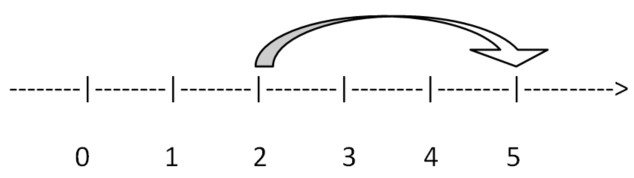
Addition means moving right on the number line.
Example: 2 + 3
- Start at 2 on the number line.
- Move 3 steps to the right.
- You land at 5.
3.2. Subtraction of Whole Numbers
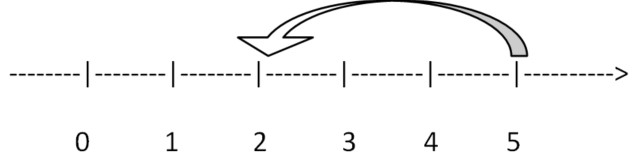
Subtraction means moving left on the number line.
Example: 5 − 3
- Start at 5 on the number line.
- Move 3 steps to the left.
- You land at 2.
4. Advanced Whole Number Operations Using a Number Line
4.1. Multiplication on a Number Line
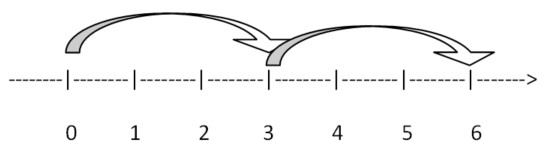
Multiplication can be seen as repeated addition.
Example: 2 × 3
- Start at 0.
- Make 2 jumps of 3 steps each to the right.
- You land at 6.
4.2. Division on a Number Line
Division can be viewed as repeated subtraction or splitting into equal parts.
Example: 8 ÷ 2
- Start at 8.
- Move 2 steps to the left repeatedly until you reach 0.
- You can make exactly 4 steps, so 8 ÷ 2 = 4

5. Complex Scenario: Mixed Operations on a Number Line
When dealing with multiple operations (addition, subtraction, multiplication, and division), use the BODMAS rule:
- Brackets
- Orders (powers and roots)
- Division
- Multiplication
- Addition
- Subtraction
Example: Solve 3 + 4 × 2 − 5 using a number line.
- First, handle multiplication: 4 × 2 = 8
- Then, addition: 3 + 8 = 11.
- Finally, subtraction: 11 − 5 = 6 .
Visualize on a number line:
- Start at 3, jump 8 steps right to reach 11, then move 5 steps left to land at 6.
6. Introducing Negative Numbers for Advanced Scenarios
In more advanced scenarios, negative numbers can be introduced:
- Addition of a negative number means moving left.
- Subtraction of a negative number means moving right.
7. Logical Challenges and Scenarios
7.1. Temperature Change
If the temperature is 5°C and it drops by 7°C, what is the new temperature? Use a number line with negative numbers.
7.2. Time on a Clock
If it’s 3 PM and you need to add 9 hours, where will the time be on a 12-hour clock?
8. Practice Questions
- Represent 4 + 6 on a number line.
- Solve 10 − 7 using a number line.
- Visualize 3 × 5 on a number line.
- Show 12 ÷ 4 on a number line.
- Solve 5 + 8 − 3 using the number line.
- Use a number line to solve 9 × 2 − 7.
- Visualize and solve 24 ÷ 6 + 5 on a number line.
- Apply a number line to 15 + 3 × 4 − 8.
- Solve 7 + 3 × (10 − 8) using a number line.
- Represent 18 ÷ 2 + 4 − 5 on a number line.
9. Practice Question Solutions
- 4 + 6 = 10
- Start at 4, move 6 steps to the right. Result: 10.
- 10 − 7 = 3
- Start at 10, move 7 steps to the left. Result: 3.
- 3 × 5 = 15
- Start at 0, make 3 jumps of 5 steps. Result: 15.
- 12 ÷ 4 = 3
- Start at 12, make 4 jumps of 3 steps to the left. Result: 3.
- 5 + 8 − 3 = 10
- Start at 5, move 8 steps right (to 13), then 3 steps left. Result: 10.
- 9 × 2 − 7 = 11
- Start at 0, make 9 jumps of 2 steps to reach 18, then move 7 steps left. Result: 11.
- 24 ÷ 6 + 5 = 9
- Start at 24, make 6 jumps of 4 steps to reach 4, then move 5 steps right. Result: 9.
- 15 + 3 × 4 − 8 = 19
- Start at 15, make 3 jumps of 4 steps to reach 27, then move 8 steps left. Result: 19.
- 7 + 3 × (10 − 8) = 13
- Start at 7, solve the brackets first 10−8=210 – 8 = 210−8=2, then multiply by 3, move 6 steps right. Result: 13.
- 18 ÷ 2 + 4 − 5 = 8
- Start at 18, make 2 jumps of 9 steps to reach 9, move 4 steps right, and then 5 steps left. Result: 8.
Practice makes perfect. We recommend you to practice topic-wise tests https://rankmadeeasy.com/courses-and-test-series . Our expert team has prepared these tests to help you become confident in each topic.
Our Social Media Presence –
https://youtube.com/@rankmadeeasy
https://www.facebook.com/groups/rankmadeeasy
https://www.facebook.com/RankMadeEasy
https://www.instagram.com/rankmadeeasy
https://x.com/rankmadeeasy
https://linkedin.com/in/rankmadeeasy